
AI in 2026: A Reality Check

As 2026 approaches, some useful evidence in AI trends comes not from product launches, but from usage data. Recent reports from OpenAI, Anthropic, and Gallup show that AI capabilities are outpacing adoption.
In “The State of Enterprise AI”, OpenAI surveyed approximately 9,000 workers across nearly 100 enterprises. The findings point to progress as well as significant underutilization.
More enterprises are using AI, and intensity of usage has increased.
Case studies suggest AI is contributing to revenue growth, improved customer experience, and shorter product-development cycles.
Models are capable of far more than most organizations have embedded into workflows, presenting a significant opportunity for firms.
In “Estimating AI Productivity Gains”, Anthropic analyzed 100,000 Claude conversations to estimate task-level time savings. Their model estimates an 80% reduction in task time, while acknowledging that real-world trials often show smaller gains (14–56%), and in some cases negative returns.
As AI accelerates some tasks, others become bottlenecks.
Transformative productivity gains come not from speeding up individual tasks, but from reorganizing production.
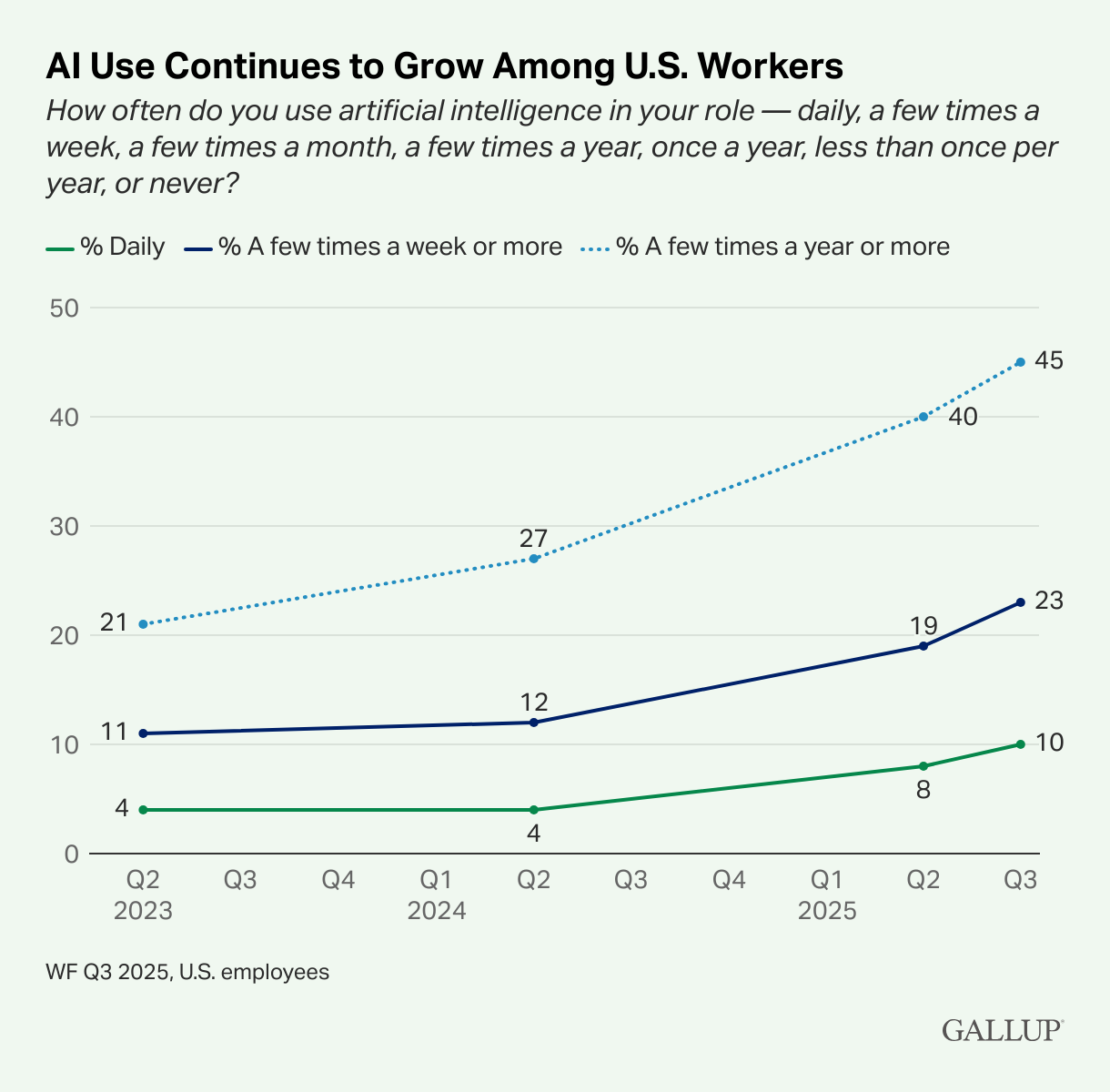
In "AI Use at Work", Gallup's survey of 23,068 U.S. adults provides an independent view of AI adoption.
Most AI users report using it to consolidate information and generate ideas.
Employees in knowledge-based roles are significantly more likely to use AI: 76% in technology or information systems, 58% in finance, and 57% in professional services report using AI a few times a year or more."
Adoption remains much lower in frontline-heavy industries: 33% in retail, 37% in healthcare, and 38% in manufacturing.
The following chart presents selected growth trends from the Gallup survey.
OUR TAKE
The capabilities of leading LLMs are now significantly ahead of organizations’ ability to adapt business models and workflows. Realizing the benefits will require updating legacy operating approaches.
Eighty percent faster task completion does not translate into eighty percent more output. Bottlenecks shift but do not disappear. Coordination, judgment, approvals, and physical constraints need to be addressed.
White-collar and digitally focused roles will see the greatest near-term transformation. Regulated industries and physical work may experience more constrained benefits, but this will shift as robotics and physical-world AI mature.